By Samindra Kunti in Los Angeles
June 15 – On the eve of their World Cup opener against New Zealand, Iran captain Mehdi Taremi and manager Amir Ghalenoei voiced their dismay at the difficult preparations their team has endured for the tournament.
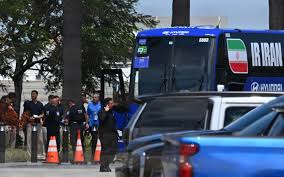
On Sunday, the Iranians crossed into US territory from Tijuana, Mexico, following a short flight to Los Angeles, where the Sofi Stadium will be the venue for the most politicised match in World Cup history. Even the team’s border crossing came with intrigue.
At a news conference, Taremi explained that they had travelled for five hours. Typically a flight between the two cities takes 45 minutes.
“I have felt the tension from the first moment we arrived at this World Cup,” said Taremi. “At any tournament when there is tension, we won’t have the same beautiful experience we always talk about with peace and joy. … I know it wasn’t just us. I know several countries had visa problems and changes with training camps. Before we arrived, the feeling, the sensation people always have, how they look forward to the World Cup, I think this time maybe they haven’t had the same feeling.”
The Iranians have a long history of playing politically charged matches at the World Cup, including at the 1998 World Cup against the US and at the 2022 World Cup following amid the ‘Women Life Freedom’ protests back home following the killing of Masha Amini. The stakes will be much higher this time after the US-led war against the country, even though the two countries reached a tentative agreement to end hostilities on Sunday.
From visa denials to a late shift of the basecamp to Mexico, Iran’s preparations have been disrupted time and again. “This kind of tension, it undermines that joy and it undermines the message of FIFA and our people, which is that football brings about peace,” said Taremi. “I feel like this World Cup could have provided a better atmosphere than it has, but I hope in the future it will be better for all fans, whatever team they are supporting in the World Cup.”
But the team awaits a heated atmosphere at the SoFi Stadium. Los Angeles is home to the largest diaspora of Iranians outside of the country and some of them plan major protests. It could lead to the awkward scenario where Iran supporters will be cheering against their team.
“We play for every Iranian, be it in the diaspora or in Iran,” Taremi said. “People have different opinions, but we are here to unite people and we will try to bring joy to all Iranians wherever they live. We do not get involved in politics. We are here to play football.”
Ghalenoei deflected a question over his team potentially walking off if faced with protests.
Contact the writer of this story at [email protected]
PakarPBN
A Private Blog Network (PBN) is a collection of websites that are controlled by a single individual or organization and used primarily to build backlinks to a “money site” in order to influence its ranking in search engines such as Google. The core idea behind a PBN is based on the importance of backlinks in Google’s ranking algorithm. Since Google views backlinks as signals of authority and trust, some website owners attempt to artificially create these signals through a controlled network of sites.
In a typical PBN setup, the owner acquires expired or aged domains that already have existing authority, backlinks, and history. These domains are rebuilt with new content and hosted separately, often using different IP addresses, hosting providers, themes, and ownership details to make them appear unrelated. Within the content published on these sites, links are strategically placed that point to the main website the owner wants to rank higher. By doing this, the owner attempts to pass link equity (also known as “link juice”) from the PBN sites to the target website.
The purpose of a PBN is to give the impression that the target website is naturally earning links from multiple independent sources. If done effectively, this can temporarily improve keyword rankings, increase organic visibility, and drive more traffic from search results.